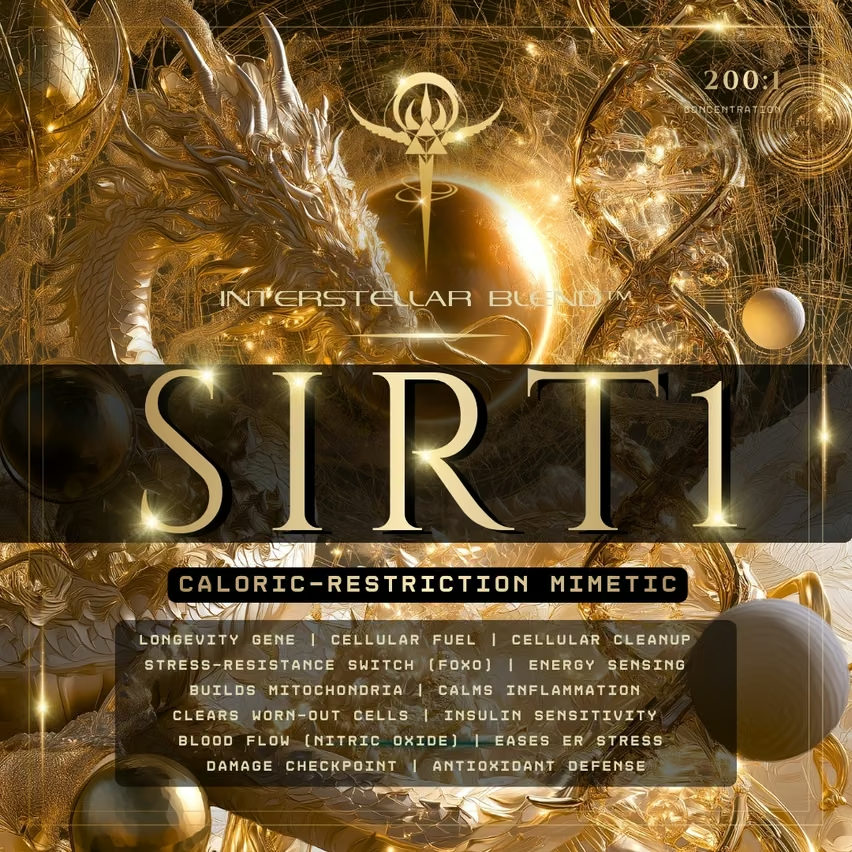
Cells run a different program when food is scarce. This one calls it up without the scarcity.
The sensor is a deacetylase that cannot act without its cofactor (SIRT1, NAD⁺) — an obligate pairing, so the ceiling is set by whichever runs short, and in practice that is the cofactor pool. The same signal raises self-digestion for recycling (autophagy) and the transcriptional arm of stress resistance (FOXO).
A scarcity program held open does the work scarcity would have done. Energy sensing opens it, built mitochondria are what it leaves behind, and the damage checkpoint is what it protects. Worn-out cells cleared, antioxidant defense, inflammation, IL-6 and body-wide inflammation fall together. Insulin sensitivity, blood-sugar handling and cholesterol give the metabolic reading, the liver and blood flow the organ one. BDNF and eased ER stress show it in tissue that rarely reports early, with sperm quality, anxiety and weight behind them.
Four primary pathways of the twenty-four it targets. A pathway opens only on graded, published evidence, shown with its source at the ingredient level.
Educational only. Not evaluated by the FDA.
The story of SIRT1 Activator (Caloric-Restriction Mimetic)
SIRT1 Activator — ‘The Longevity Switch’ — for the program your cells run when food is scarce. For almost all of history, food was not guaranteed. Bodies adapted to famine with a remarkable response: when fuel runs short, cells stop investing in growth and start investing in repair. They tidy themselves, protect their DNA, and become harder to damage. In animals, living with a little less food, consistently, is one of the most reliable ways ever found to extend healthy life. The trouble, for people, is that it means living hungry. The switch that runs this program sits inside the cell, reading its energy state (SIRT1). When energy is scarce, a particular molecule rises in the cell (NAD+, the vital currency), and SIRT1 uses it as fuel. The switch turns on and begins removing chemical tags from the proteins that decide how the cell behaves, changing their orders one by one. Two of those orders matter most. It hands control to a family of longevity factors that switch on the cell’s defenses against stress, damage and oxidants (FOXO). And it starts the cell’s deep cleaning, the process that wraps worn-out parts and breaks them down for reuse (autophagy). With the years, the switch weakens. The currency it runs on falls with age, so the program that once answered every lean season answers less and less. SIRT1 Activator is a calorie-restriction mimetic. It supplies the signals a cell reads during scarcity, feeds the switch the currency it needs, and lets the longevity factors and the deep cleaning run, without asking you to live on less. A scarcity program held open does the work scarcity would have done. Cellular cleanup is the deep part of it, and built mitochondria are what the program leaves behind. Calmed inflammation, body-wide and in its inflammatory signaling, settles as the backlog clears; antioxidant defense stops being outspent; and insulin sensitivity, blood-sugar support, cholesterol and weight read the whole of it metabolically. Blood flow opens, the liver lightens, and BDNF signaling holds where stress had been eroding it. Sperm quality, a settled gut and anxiety are the slower reports — the ones that arrive after a person has stopped expecting anything else to change. Your cells still carry the famine program. SIRT1 Activator switches it on at the table.
The longevity-gene flagship — calorie-restriction mimicry.
★ 5.0 · 200:1 · $99




The studies, ingredient by ingredient
Its KPMF-8 sped the human SIRT1 enzyme 8.2-fold on its natural target; resveratrol manages 1.4-fold.
In a four-year randomized trial, raised SIRT1 protein and lowered cardiovascular deaths, given with selenium.
Saffron's crocin lifted the signal for two energy-sensing enzymes in people with coronary artery disease.
Binds SIRT1 directly and raises its activity, building mitochondria and energy in heart and nerve cells.
Ferulic acid's effect on the energy-sensing pathway survives the hardest test available in an animal: block SIRT1 with a chemical that shuts the enzyme down, and the benefit disappears along with it.
In animals the case closes properly: shut the enzyme down with a blocker and the benefit goes with it, so the effect is the enzyme's doing.
Ursolic acid grips the outer face of SIRT1 and holds it in its working shape.
A stilbene glucoside that switches on SIRT1 in living animals, with the energy-sensing route alongside.
Allicin donates hydrogen sulfide, and hydrogen sulfide switches SIRT1 on by chemically modifying its zinc-finger domains — shown rigorously in mice bred without the enzyme that makes it. The rigor sits on the hydrogen-sulfide step; allicin's part is supplying the donor. Animal evidence.
In animals alpha-lipoic acid raises SIRT1, a cell-maintenance enzyme, across metabolic and antioxidant models.
Astragaloside IV, a single saponin pulled from astragalus, raises SIRT1 and the cell's energy sensor across several animal models, including mice bred without calpain-1.
Berberine's glucose-lowering is linked to activation of AMPK, the cell's energy sensor, with more glucose taken up, less released by the liver and more fat burned.
Carnosic acid, the rosemary diterpene, protects tissue in living animals by lifting a molecular brake off SIRT1, a chain traced step by step in rodents.
Catalpol lifts SIRT1 through the energy-sensing route in animals, in diabetic and nerve-protection models alike.
The work behind cordyceps belongs to cordycepin, the molecule inside it: in animal models of metabolic and kidney disease, cordycepin raises SIRT1 and the cell's energy sensor.
Turmeric's curcumin raises SIRT1 in animals, and there the change carries through to something measurable: hearts came through an interrupted blood supply in better shape.
Its salvianolic acids and tanshinones each raise SIRT1, and animal studies show the whole extract doing it too.
The glucoside form is how the body takes it up.
Across animal work on fatty liver, metabolic strain and nerve injury, raised SIRT1 alongside measured improvement.
The omega-3 fat DHA quiets an inflammatory switch in cultured immune cells by working through SIRT1.
In animals ellagic acid raises SIRT1, a cell-maintenance enzyme, protecting liver and nerve tissue.
Horsetail extract was fed to rats made diabetic by a chemical that destroys the insulin-producing cells of the pancreas, and SIRT1 rose in the treated animals.
Fisetin nudges SIRT1 directly and pushes it harder by the indirect road, raising both the amount of enzyme present and the marks it leaves on its targets in animal tissue.
Formononetin, a plant isoflavone, lifts SIRT1 and the energy sensor above it in animals, across a spread of organ-protection models.
In animal models of nerve injury, gastrodin raises SIRT1.
Soy's genistein raises SIRT1 in animal metabolic and heart models.
Bilobalide, one of ginkgo's terpene lactones, switches on the energy sensor and SIRT1 beneath it in an animal model of joint degeneration.
Fed to genetically diabetic mice, ginsenoside Rb2 raised SIRT1 and the energy sensor above it and restored the cells' self-clearing housekeeping.
In animals, grape-seed proanthocyanidins raise the liver's NAD+ and its SIRT1 in step with the amount given.
Hesperetin raises SIRT1, a cell-maintenance enzyme, in animal models of treatment-related heart damage.
A 2003 fluorescence screen also called it a direct activator.
Several animal models show the same pattern, and that indirect route is stated plainly.
Luteolin raises SIRT1 in a run of animal studies, several of which closed the loop by abolishing the effect with a chemical that shuts the enzyme down.
The long sugar chains of the goji berry raise SIRT1 in animals across eye, nerve and metabolic models.
In an animal model of sun-driven skin aging, lycopene raises SIRT1, a cell-maintenance enzyme.
Nicotinamide riboside raises NAD+, the fuel SIRT1 runs on, and that rise is proven in people — about a 2.7-fold increase in blood cells.
Niacin, the oldest known NAD+ precursor, raises NAD+ by its own well-established route, refilling the fuel SIRT1 runs on.
Like NR: human randomized trials confirm it safely raises the NAD+ metabolome; downstream SIRT1 *activity* increase in humans is inferred, not directly demonstrated.
Notoginseng's activity lives in three of its saponins, and in animal heart and nerve models those constituents raise SIRT1.
What stands is a rise in SIRT1 levels in cultured human immune cells, plus repeated appearances in heart-protection screens.
A flavanone with a decent animal record in nerve injury, pinocembrin raises SIRT1 in those rodent studies.
SIRT1 rises in animals given it.
In animals it raises SIRT1 with the mitochondria-building program and a sister enzyme, and it carries resveratrol's open question about which targets get sped.
Kudzu's puerarin repeats itself in animals: SIRT1 and the energy sensor above it rise in heart-protection and diabetes models, study after study, which is the sturdy part of its record.
Quercetin shifts SIRT1 in animals and in cells alike, and reference databases list it among the direct activators.
In a randomized trial, muscle biopsies showed resveratrol raised the activated form of AMPK, the cell's energy sensor.
Salidroside, the marker compound of rhodiola, raises SIRT1 across several animal organ-injury models.
Raises how much SIRT1 a cell makes, earning its place in animal organ-protection work.
Block SIRT1 with a chemical that shuts it down, and the benefit in these animals disappears.
The route is more of the enzyme plus the energy sensor, not direct activation.
Built to switch SIRT1 on, its grip on the enzyme was shown directly in crystal structures.
SRT2104 is the purpose-built synthetic, tuned on the bench for selectivity toward SIRT1, and it has been through early human trials in psoriasis, type 2 diabetes and older adults.
Human vessel cells make more SIRT1 with this lignan; silence its route and the effect vanishes.
Curcumin's main breakdown product is the part the body actually absorbs, and in animals it raises SIRT1 activity the way the parent spice compound is credited with doing.
In randomized human trials urolithin A improved muscle strength and mitochondrial health; in animals with diabetic heart disease it raised SIRT1.
A phenylethanoid glycoside, also called acteoside, that induces SIRT1 in living tissue — shown in skin and neuroprotective work.
What was actually measured is more SIRT1 in cultured nerve cells, with nerve protection following in animals.
These grades describe the maturity of the published science for each ingredient — not a claim that the product treats, cures, or is clinically proven for any goal. These statements have not been evaluated by the Food and Drug Administration. This product is not intended to diagnose, treat, cure, or prevent any disease.