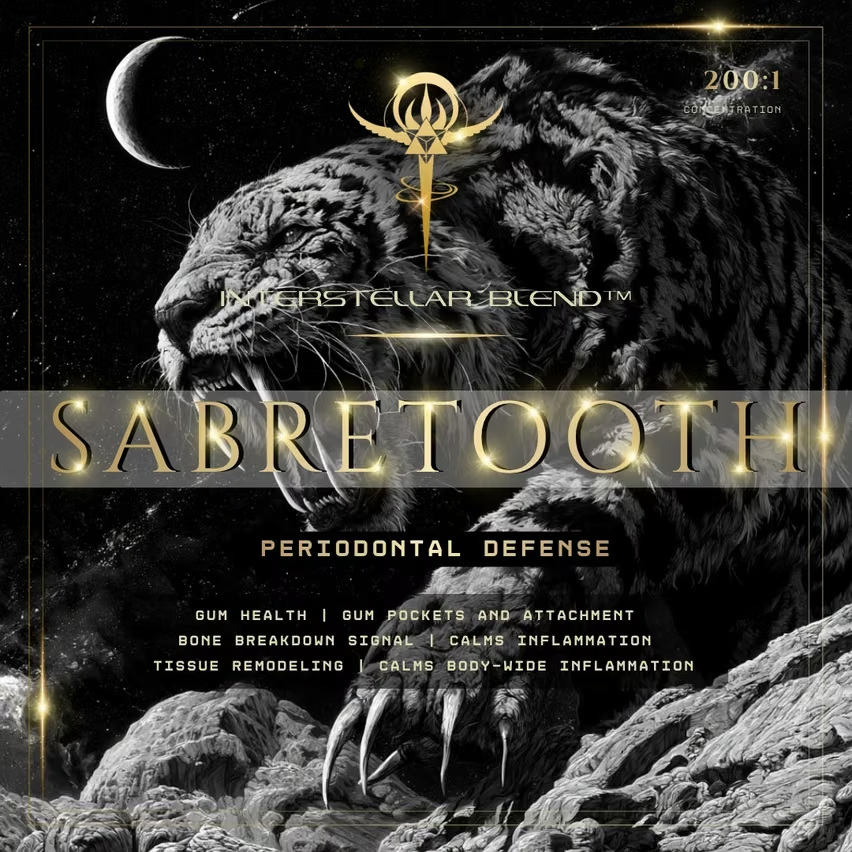
Periodontal loss is bone loss, and bone is not reached from the surface.
Attachment is lost before teeth are. Inflammation at the gum line raises the signal that recruits bone-resorbing cells (RANKL), and what gives way is the bone holding the tooth in its socket — so a pocket deepens long before anything feels loose. Collagen remodeling is the repair side of that same ledger, held back by the transcription that sustains the inflammation (NF-κB). Reaching that bone through the circulation, rather than by anything applied to the gum above it, is the whole point of the route. Body-wide inflammation calmed is what lowers the signal wherever it is raised, and gum health is what holding that line is for.
Six primary pathways. A pathway opens only on graded, published evidence, shown with its source at the ingredient level.
Educational only. Not evaluated by the FDA.
The story of Sabretooth (Periodontal Defense)
Sabretooth — ‘The Gatekeeper’ — for the gums, the pockets and the bone that holds your teeth. Every tooth you own is anchored the way a gatepost is: sunk into bone, sealed at the surface by a collar of gum. For decades that seal holds, and the gate between your mouth and the rest of your body stays closed. When it fails, the mouth becomes something most people never think of it as, an open wound into the bloodstream (periodontal inflammation, the mouth that leaks). It fails slowly. Bacteria collect in the narrow pocket between gum and tooth. The gum inflames, the pocket deepens, and the body, fighting what it cannot reach, turns its weapons on its own tissue. The master inflammatory switch stays thrown (NF-κB). The bone that holds the tooth receives the order to dissolve (RANKL, against its decoy OPG). And the collagen fibers that tie the tooth into its socket are broken down faster than they are rebuilt (type-I procollagen). The damage does not stay in the mouth. Inflammation that begins at the gumline travels (systemic inflammation). The health of the gums is increasingly read as a mirror of the health of the whole body (oral & periodontal health, the mouth as a systemic organ). Sabretooth works from the inside out, where a rinse or a brush cannot reach. Taken into the body, it cools the switch that keeps the gum inflamed, withdraws the order to dissolve the bone, and supports the collagen that ties each tooth in place, so the collar of gum can seal again. A gate is only as strong as its posts. Sabretooth keeps yours standing.
Gum & oral-microbiome defense.
★ 5.0 · 200:1 · $99


The studies, ingredient by ingredient
In a placebo-controlled trial of 300 adults, every aged garlic arm closed periodontal pockets more than placebo, with a dose-response trend.
Taken with standard gum therapy, lycopene reduced pocket depth and restored attachment more than placebo.
Taken after deep cleaning, CoQ10 lowered pocket depth, lost attachment, bleeding and plaque more than placebo.
Omega-3 taken with gum therapy reduced bleeding and restored attachment; pooled across trials, pockets closed and attachment returned by about half a millimeter more.
Ginger taken with gum therapy restored attachment and closed pockets more than placebo.
In a randomized trial of adults aged 65 and over, 13% of those taking calcium with vitamin D lost a tooth, against 27% on placebo.
Pine bark extract lowered MMP-8 in saliva, the enzyme that breaks down the tissue holding the teeth, more than placebo.
A cranberry drink taken after gum therapy lowered the gingival and plaque indices more than water.
Eaten bilberries lowered bleeding gums against placebo and cut the inflammatory signals in gum fluid.
Drunk daily, specific collagen peptides left fewer bleeding gum sites than placebo in patients on periodontal aftercare.
Across fifteen trials, vitamin C lowered the gums’ tendency to bleed where blood levels of the vitamin had been low.
A daily probiotic milk drink halved gum bleeding and gum-fluid volume as plaque built up.
Resveratrol lowered plaque more than placebo in people with gum disease, and in rats it halved the loss of jawbone.
Across randomized trials, dietary nitrate lowered gum inflammation and shifted the mouth’s bacteria toward nitrate-reducing kinds.
Curcumin lowered gum inflammation and papillary bleeding more than placebo in gingivitis and mild periodontitis.
Taken by mouth, quercetin cut the loss of jawbone around the teeth in two independent laboratories.
Baicalin, the flavone of Chinese skullcap, sharply reduced the loss of jawbone around the teeth in rats.
Chinese skullcap itself, the plant rather than its isolate, preserved the jawbone around the teeth in rats, in a second laboratory.
Magnolia bark’s magnolol cut jawbone resorption, the bone-dissolving osteoclasts and the RANKL signal that summons them.
N-acetylcysteine reduced damage to the jawbone around the teeth in rats.
Alpha-lipoic acid left less jawbone damage and more collagen around the teeth in rats.
Lactoferrin, protected in liposomes, cut the bone-dissolving osteoclasts along the jawbone in rats; unprotected lactoferrin did not.
These grades describe the maturity of the published science for each ingredient — not a claim that the product treats, cures, or is clinically proven for any goal. These statements have not been evaluated by the Food and Drug Administration. This product is not intended to diagnose, treat, cure, or prevent any disease.