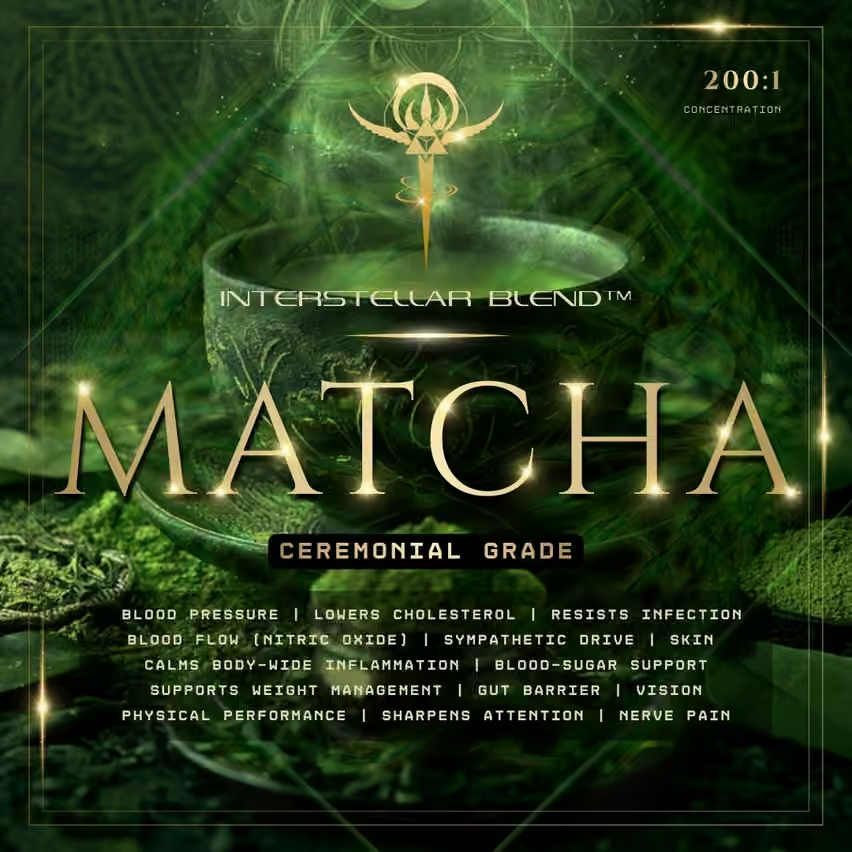
Shade changes what the leaf makes, not merely how it tastes.
Denied full light in the weeks before harvest, the plant accumulates amino acids and catechins in place of the bitter compounds of open-grown tea; that shift is what ceremonial grade actually names. Its best-established actions converge on the vessel wall from three directions — blood pressure, the cholesterol panel, and endothelial nitric oxide (eNOS), which governs whether the vessel can widen at all.
The same leaf reaches well past the vessel. Attention and alertness sharpen without the sympathetic drive that coffee brings, and mood and social cognition move with them; body-wide inflammation is calmed, and the surfaces that show it first follow — the gut barrier, skin and gum health. Vision and nerve pain answer to the same polyphenols, arterial stiffness to the same endothelium. Physical performance and blood-sugar handling read it systemically, with resistance to infection and weight behind them.
Three primary pathways of the twenty-one it targets. A pathway opens only on graded, published evidence, shown with its source at the ingredient level.
Educational only. Not evaluated by the FDA.
The story of Interstellar Matcha (Ceremonial Grade)
Interstellar Matcha — ‘The Covered Field’ — for the plant that was kept from the light. Weeks before harvest, the tea field is covered. The sun is taken away on purpose. And the plant, denied the thing it lives on, does not wither. It concentrates. The leaves deepen to a vivid green, richer and sweeter than any leaf grown in open sun, and they are picked, steamed, dried and stone-ground whole into a fine jade powder. With ordinary tea you drink an infusion and throw the leaf away. With matcha you take the whole leaf. That difference matters for your circulation. The compounds a shaded leaf gathers speak to the lining of your blood vessels, encouraging it to release the gas that relaxes and widens them (eNOS, endothelial nitric oxide). Wider, suppler vessels ease the force the heart must push against with every beat (blood pressure). And the same leaf supports the orderly handling of fats in the blood, how they are packaged, carried and cleared (lipid metabolism). The three are one system. A lining that makes its own relaxing gas freely keeps the pressure inside the vessels low; fats that are carried and cleared in good order leave that lining smooth and responsive; and a lining under less pressure stays younger for longer. Each one keeps the others in good repair. Tea masters have prized shade-grown leaf for centuries, for its depth of taste and its calm, focused lift. The circulation had reasons of its own to prize it, whether anyone knew them or not. Interstellar Matcha is a single-origin powder of that covered field, taken whole, as it was always meant to be. One leaf reaches further than its reputation. It lowers cholesterol with the same polyphenols that open the vessel, and arterial stiffness answers them over years rather than weeks. It sharpens attention and alertness without the sympathetic drive coffee brings, so mood and social cognition move with them rather than against them. Body-wide inflammation calms, and the surfaces that show it first follow — the gut barrier, the skin, gum health, vision, and the nerve pain that answers to the same chemistry. Allergy load eases. Blood-sugar support and PCOS read it hormonally, physical performance reads it systemically, and resistance to infection sits quietly behind all of it. Some things grow stronger in the dark. This leaf is one of them.
Ceremonial-grade leaf, shade-grown and stone-ground whole. Cholesterol, blood sugar, endothelial function and attention.
★ 5.0 · 250g · $75

The studies, finding by finding
55 randomized trials, 4,874 people: total cholesterol and LDL down, HDL up, on moderate-certainty evidence.
From the same trials: fasting glucose and HbA1c both fell significantly.
Thirty-four trials: peak oxygen uptake rose while BMI and body fat fell.
Ten studies, 3,748 people: infection risk about a quarter lower, holding in the randomized arms too.
Sixteen trials, 760 people: the blood's total antioxidant capacity rose significantly.
In 175 people, redness after ultraviolet exposure fell, measured against placebo as well as against baseline.
In human trials, measured by ultrasound on the brachial artery of living participants, flow-mediated dilation rose 2.6 percentage points of arterial diameter.
Only the whole leaf raised flow-mediated dilation, by 1.36 percentage points.
Systolic pressure fell 1.98 mmHg and diastolic 1.92 mmHg.
Fat mass fell, and visceral fat, the fat around the organs, fell alongside it.
Body mass index fell 0.72 at across the pooled trials in people already carrying the metabolic syndrome diagnosis.
Body weight fell 2.71 kg, with fasting insulin and glucose following.
Fibroid volume fell 32.6 percent on EGCG while the placebo group averaged a 24.2 percent increase.
Protein leaking into the urine, the earliest sign the kidney's filter is failing, fell 41 percent, from a median 210 to 133 mg/g.
Heart-muscle mass measured by cardiac MRI fell 6 percent, from 196 to 180 grams, with cholesterol falling alongside.
Over eight weeks, anxiety scores fell significantly, and general psychopathology with them.
Social acuity improved, with errors of commission in emotion perception falling alongside.
Bone-specific alkaline phosphatase, the marker of bone actively being built, rose significantly within one month.
Hemoglobin rose significantly by day 60, with the placebo arm unmoved.
At twelve months the treatment arm carried 16 percent higher total estradiol, 3.7 against 3.2 pg/mL.
In patients receiving radiotherapy, the adjusted pain index ran 8.62 on EGCG against 15.42 on conventional care — roughly half.
Resting metabolic rate rose 43.82 kcal a day in one study and 260.8 in another, with a shift in which fuel the body reached for.
Sweating rate rose significantly above placebo, measured directly, the key to clearing heat in sustained effort.
Subjective fatigue was significantly lower on matcha at week one.
EGCG reaches the bloodstream, measured in people.
Clinical response ran 50 percent across the green tea arms against 18.2 percent on placebo.
In animals, lowered weight gain, liver weight, kidney and skin fat pads, glucose and triglycerides.
Pancreatic endocrine area more than doubled, with insulin content rising against diabetic controls.
Leakage across the gut wall, read by a tracer that crosses only a damaged barrier, fell to 2.85 ng/mL against 6.69 in the untreated model.
Against induced colitis, EGCG lowered the disease activity index and preserved colon length, with the beneficial bacterial populations rising.
Eradication reached 36.4 percent when catechins were delivered in both food and water against 10 percent by food alone.
Of thirteen ceramide species tracked, six were raised by a western-pattern diet and EGCG lowered two of those six.
Creatine kinase, the leak marker of muscle damage, fell 57%.
Sperm concentration rose, and vitality, the share of cells still alive, rose 40 to 54.8 percent.
Antibodies directed against the body's own collagen fell significantly, while regulatory T-cells — the cells whose job is to stop that attack — doubled.
These grades describe the maturity of the published science for each ingredient — not a claim that the product treats, cures, or is clinically proven for any goal. These statements have not been evaluated by the Food and Drug Administration. This product is not intended to diagnose, treat, cure, or prevent any disease.