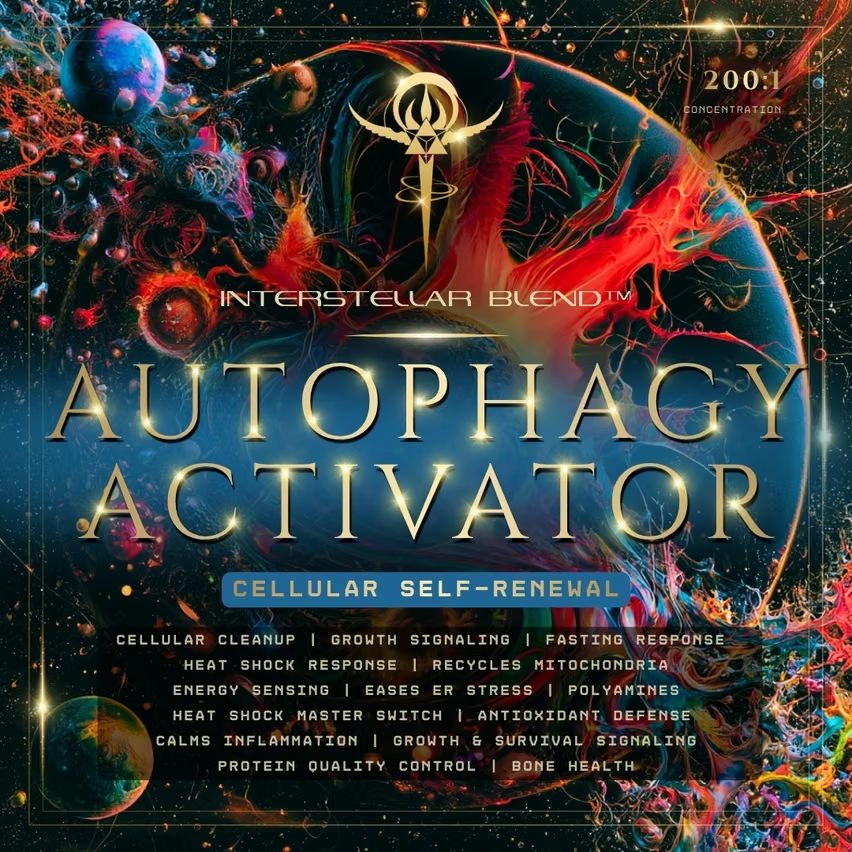
Cells do not so much repair their damaged parts as digest and rebuild them.
It happens in bulk, and selectively for mitochondria (mitophagy), and it is induced by the absence of feeding (fasting response). Quality control runs in parallel through chaperones under one master switch (HSF1), with the secretory compartment reporting its own load (ER stress), polyamines supporting the process, and bone among the tissues depending on this turnover.
Renewal is gated by the fuel state above it: energy sensing opens it, growth restraint is the other half of the same switch, and the longevity gene runs the program they share. What renewal buys reads across the body — worn-out cells cleared, antioxidant defense raised and inflammation calmed, blood-sugar handling, fasting insulin and insulin sensitivity improve as the backlog clears. The liver and cholesterol carry the metabolic half and cortisol the hormonal one, with sperm quality, resistance to infection and weight reading the rest.
Nine primary pathways of the thirty-eight it targets. A pathway opens only on graded, published evidence, shown with its source at the ingredient level.
Educational only. Not evaluated by the FDA.
The story of Autophagy Activator (Cellular Self-Renewal)
Autophagy Activator — ‘The Renewal’ — for the housekeeping your cells stop doing while you are not looking. Each cell in your body is a small city, and every city makes waste. Proteins wear out and misfold. Engines break down. Membranes tear. A healthy cell does not merely tolerate the debris. It wraps it in a membrane, carries it to a furnace and breaks it into parts it can use again (autophagy). Old machinery becomes raw material for new. You cannot feel this happening, and that is precisely the problem. The recycling slows with the decades, and a cell that stops taking out its trash does not announce it. It simply grows cluttered, sluggish and inflamed, and in time so does the tissue it belongs to. The clearance has departments. One curates the power plants, singling out damaged mitochondria and dismantling them before they leak (mitophagy). One keeps the whole workforce of proteins in balance, built, folded and retired at the right pace (proteostasis). One runs the folding room, where new proteins take their shape and where a backlog of misshapen ones becomes a distress call of its own (ER stress, the unfolded protein response). Its chaperones walk the floor, refolding what can be saved and flagging what cannot (heat-shock proteins). What throws the master switch is scarcity (caloric restriction and fasting). When fuel runs short, the cell stops building and starts cleaning, which is part of why a fast can feel like a reset. Some of the signal also arrives with food, as small molecules the cell reads as permission to begin (polyamines, spermidine). The renewal is not only microscopic. Bone is living tissue, dismantled and rebuilt all your life, and the cells that rebuild it depend on the same clearance to stay productive (bone density). A frame is renewed the way a cell is: by removing what is worn. Autophagy Activator sends the scarcity signal without the empty plate. It gives your cells the cues they would read during a fast, and asks the recycling to run at the pace it kept when you were younger. Cleanup that runs properly pays out in places nobody connects to housekeeping. Energy sensing opens the program and growth restraint is its other half, with the longevity gene running what the two share; the hypoxia response and sugar burning decide what fuel the work is done on. As the backlog clears, worn-out cells go with it, inflammation, its alarm and inflammatory signaling settle, and antioxidant defense stops being spent faster than it is made. The liver lightens. Blood-sugar support, insulin sensitivity, fasting insulin and cholesterol read the clearance metabolically, and weight follows them. Blood flow opens, clotting keeps its order, the kidney clears, and resistance to infection rises where the gut had been the weak point. Cortisol and anxiety come down on the stress axis, mood and the alertness chemical come up, and growth and survival signaling decide what gets rebuilt in the space the clearing made. Renewal is not something you add. It is something you allow.
Fasting-mimetic deep cellular cleanup.
★ 5.0 · 200:1 · $99







The studies, ingredient by ingredient
In roundworms it raises the clean-up machinery and extends lifespan by about 30%.
In human immune cells, switches on cathelicidin and the cell's disposal machinery; a human trial has measured the first step.
In immune cells taken from donors over 65 and treated in the lab, spermidine restored the autophagy clear-out that had slowed with age.
Urolithin A restored PINK1- and Parkin-dependent mitophagy in the kidneys of fructose-fed mice.
Apigenin starts the recycling crew by the fasting route, and the clean-up is real: the p62 cargo that piles up when recycling stalls comes down, and stressed mice recover recycling in the hippocampus.
Berberine switches on the cell's energy sensor, releasing the brake on autophagy, the cell's clear-out of damaged parts. Shown across fatty-liver, kidney and liver-transplant models, all of it cell and animal work; in heart-injury models it restrains autophagy that has run too far.
In animals this reduces fatty liver, and silencing the sensor abolishes the effect, proving the route.
In mice carrying the Machado-Joseph mutation, cordycepin cleared the toxic ataxin-3 clumps the disease piles up, by pushing cells to throttle protein-making and raise recycling instead.
Α-synuclein is the protein that clogs Parkinson's neurons, and corynoxine B clears the normal and the mutant form alike — A53T transgenic mice and fruit flies moved better for it.
Turmeric's polyphenol wakes the cell's energy sensor, and that releases the switch holding recycling shut. Knock the sensor out and curcumin does nothing whatsoever, the cleanest proof there is.
In rats on a high-fat diet it improved muscle insulin resistance.
Algal omega-3 gets fat cells to dismantle their own worn-out mitochondria — measured in living animals, and abolished when the receptor it works through is blocked.
A standardized ginkgo extract in clinical use for dementia.
Soy's isoflavone drives the cell's energy sensor both ways: cripple the sensor and genistein stops working, force it on and the effect accelerates.
The enzyme USP14 holds a brake on the cell's recycling switch, and gingerol jams it: flood the cell with extra USP14 and the effect vanishes.
Honokiol, the biphenyl of magnolia bark, drove strong autophagy in cells and raised the autophagy marker LC3B-II in treated mice.
Magnolol clears amyloid in APP/PS1 mice.
Kaempferol stabilizes the cell's energy sensor by destroying the protein that degrades it — a two-step route most flavonols do not have.
Plenty of compounds raise the markers of self-digestion without the process ever finishing. Matrine's was confirmed the harder way, by blocking the exit and watching the cargo pile up, and silencing Beclin1 stops it.
This triterpenoid hits the energy sensor and three growth pathways at once, and a chemical blocker and a silenced Beclin1 gene each stop the self-digestion it starts.
Pancreatic, colorectal and cardiac animal models all answered to oridonin, and orthotopic pancreatic disease is about as unforgiving a test as exists.
Cells switched on autophagy shortly after parthenolide, feverfew's active, through a signal traced step by step to the loss of 4E-BP1.
Allspice berry water extract switches on the cell's self-clearing program by shutting down its growth-signaling hub. Silence the clearing genes and the effect stops, which is how the cause was proved.
Long pepper's alkaloid raises reactive oxygen inside the cell until it begins consuming its own damaged parts. Mop the oxygen up, or delete the gene that starts the clearing, and the effect vanishes.
In animals it reduces fatty-liver severity.
Resveratrol clamps the master growth switch directly and wakes the two energy sensors that order a cell to clear out its own wreckage, clumped Parkinson's and Alzheimer's proteins included.
Salidroside, the active drawn out of Rhodiola rosea, hits the recycling switch from both sides at once - waking the energy sensor and quieting the growth hub.
Red sage's diterpene quinone pushes cells to build disposal vesicles by pinching the growth pathway shut and firing the energy sensor. Knock out the one gene that starts the process and the benefit disappears, in cultured cells and in live animals alike, failing-heart models among them.
In diabetic mice and kidney cells it restores the autophagy that high blood sugar had shut down.
Concentrated from sprout glucoraphanin, sulforaphane turns on the program that makes cells consume their own stored fat.
In cell studies, alisol B, the strongest of three Alisma triterpenes tested, switched on autophagy by blocking SERCA, the cell's calcium pump.
Cells starved of oxygen and glucose survived better once black soybean pigment switched their internal recycling on.
Its polyphenols switched on cellular clean-up and lowered oxidative damage in the kidneys and hearts of diabetic rats.
Pooled across eight randomized trials, bitter melon lowered fasting and after-meal blood sugar.
Animals under diabetic ischemia-and-reperfusion stress held the same protection.
Growth and its spread both slowed in animals, by a genuinely separate route.
The wax-apple chalcone turns the cell's own recycling machinery on, and three separate blockades of that machinery each reverse the effect, proved in cultured cells.
It restores a cell's disposal system by lifting the growth brake that keeps it shut, and two hard animal diseases answered: ulcerative colitis and silica-scarred lung.
In mice, amla fruit extract switched on self-digestion without triggering cell death, and quercetin, one of its own compounds, reproduces it.
Evodiamine, the alkaloid of Evodia, raised autophagosome formation in cells and in animals.
Fisetin, a dietary flavonol, blocks the cell's main growth switch on both arms and turns on the master clean-up and antioxidant regulators, switching autophagy on; the same regulator drives tau clearance. Cell studies.
Brown-algae carotenoid: after traumatic brain injury in animals it turned the cell cleanup pathway on and the injury eased.
Galangal's flavonol strips an acetyl group off the cell's recycling tag — an unusually well-pinned mechanism.
Ginger's heat compounds, shogaol and gingerol, are the actives, and two different blockers of self-clearance each cancel what they do. In human trials, ginger lowered CRP and TNF-alpha.
Huaier, a medicinal fungus already used in the clinic, switches on self-digestion in cells, and blocking the digestion undoes the effect.
Sister to corynoxine B, and a second way onto the same arm.
In animals given this dietary flavone, the electron microscope found cells packed with fresh disposal vesicles, the self-clearing program switched on, and luteolin reaches it by two routes at once.
In animals it protects the brain in Alzheimer's and aging models.
Ginsenoside Rb2 restored the stalled disposal system in liver cells of diabetic db/db mice, and blocking either sensor it runs through reverses that.
The medicinal mushroom's extract makes cells in the dish digest their own damaged parts instead of dying outright.
The black-pepper alkaloid switches off the two growth signals that stop a cell recycling its own worn-out parts.
Rhodiola's root works through salidroside, its active: the energy sensor comes on, the growth hub goes quiet, and disposal traffic starts moving.
Kamala tree resin turns the energy sensor on and the growth hub off, and stem-cell cultures answer by building the vesicles that carry damaged parts away. Silence any one of the three genes running that clearing and the effect disappears. Cell culture is where this evidence stands.
Switches on the cell's energy sensor; in animals after interrupted blood flow to heart or brain, damage was smaller.
Smilax rhizome extract tilts the cell's oxidation balance until its damage-sensing kinases order a clear-out, and antioxidants cancel the effect outright, the sharpest sign the oxidative tilt is the mechanism.
Milk thistle's flavonolignan does not just start the clean-up, it keeps the line moving all the way to disposal, traced in cultured cells with three separate blockers used to prove the traffic was real.
Ursolic acid strains the cell's protein factory until it calls for a clear-out, then pulls the same lever again through the calcium-driven energy sensor.
Vitamin K2 pushes cells into a sugar-burning state, tripping the energy sensor, lifting the growth switch and driving autophagy; silencing the oxygen-sensing signal stops that, proving the route.
Ring-shaped sugars (in the study, 2-hydroxypropyl-beta-cyclodextrin) pull cholesterol from cell membranes, sending the master clean-up regulator into the nucleus to switch on many autophagy genes.
These grades describe the maturity of the published science for each ingredient — not a claim that the product treats, cures, or is clinically proven for any goal. These statements have not been evaluated by the Food and Drug Administration. This product is not intended to diagnose, treat, cure, or prevent any disease.