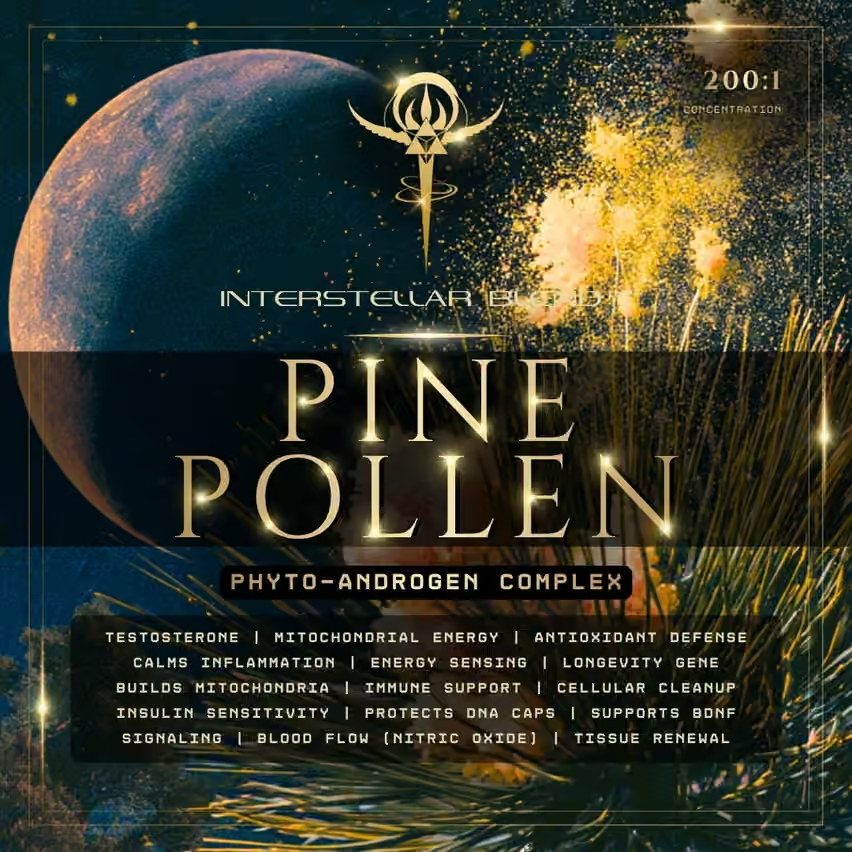
Pine pollen carries an androgenic reputation that long predates any means of testing it.
Pine pollen is gathered in the brief window it is shed, and like all pollen it is male reproductive tissue — the basis of that use (testosterone). The second action studied is mitochondrial energy production, and the pairing matters more than either term alone: drive built on hormone outruns the cell's capacity to supply it, and arrives as agitation, not as strength.
A phyto-androgen arrives with the rest of a pollen grain. Antioxidant defense and calmed inflammation are what let an androgen signal land on tissue able to use it; energy sensing, the longevity gene, built mitochondria and cellular cleanup are the maintenance underneath; sperm quality and tissue renewal are where the same grain reports most directly, DNA caps and blood flow where it reports most slowly, and BDNF, immune support and insulin sensitivity where an androgen signal is felt as something other than androgen.
Two primary pathways of the sixteen it targets. A pathway opens only on graded, published evidence, shown with its source at the ingredient level.
Educational only. Not evaluated by the FDA.
The story of Pine Pollen (Phyto-Androgen Complex)
Pine Pollen — ‘The Golden Dust’ — for the vitality a forest spends everything to make. Every spring, for a few days only, pine forests release clouds of gold. The pollen drifts in such quantity that it dusts lakes, cars and rooftops yellow, and it is the tree’s most concentrated investment in the next generation. Pine pollen is the male half of the pine’s reproduction, the tree’s own sire, gathered in the brief window when it is released. Traditional medicine in China has used it for centuries, long before anyone could say what it held. Modern physiology gives that tradition a vocabulary. Vitality in a man’s body is written in one hormone above all (total testosterone): it sets drive and confidence, and it directs the rebuilding of muscle and bone. And vitality in every cell, in every body, is written in the engines that turn fuel into usable energy (mitochondrial function). The two are joined more closely than most people realize: the very first step in building the hormone takes place inside the mitochondrion itself. Balance is the point, not excess. Where androgens run too high, the prostate enlarges under the pressure of their most potent form; where they are lost, bone and muscle thin. In the laboratory, pine pollen has stood on both sides of that axis: it protected the prostate when androgens were driven high, and it held bone and muscle in place when they were taken away. Pine Pollen is the pollen alone, gathered in the brief golden window and concentrated whole. A phyto-androgen arrives with the rest of a pollen grain. Antioxidant defense and calmed inflammation are what let an androgen signal land on tissue able to use it; cellular cleanup and tissue renewal are the maintenance underneath; and the caps on the chromosomes are protected rather than extended. Sperm quality is where the same grain reports most directly, blood flow and orderly clotting where it reports most slowly, and BDNF signaling, immune support and insulin sensitivity where an androgen signal is felt as something other than androgen. A forest puts everything it has into a few days of gold. Pine Pollen gathers it for you.
Pine pollen has been on the official record since 659, in the world's first national pharmacopoeia. Coagulation, androgens and oxidative defense.
★ 5.0 · 250g · $75
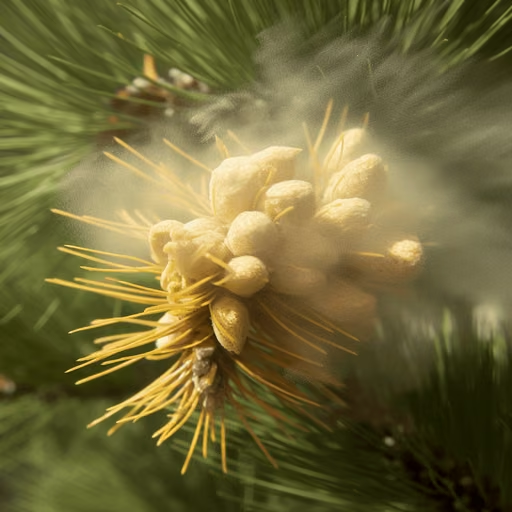
The studies, finding by finding
Pine pollen, the whole male pollen of the pine.
Under chemical load, the polysaccharide lowered every enzyme that leaks into the blood when liver cells are injured, and raised the two antioxidant enzymes that clean up afterwards.
Under cadmium, one of the harshest oxidative insults, pine pollen brought down the marker of fat under attack and raised the body's own superoxide dismutase.
In colitis, restored the three proteins that seal the intestinal wall.
Under arsenic, cortical cells dying by programmed death fell to 6.95 percent against 21.64 in the untreated model — roughly a third.
In castrated male rats, pine pollen held bone density and strength at the level of testosterone replacement over sixty days, at the stronger of two intakes.
Raised the ovarian index, halved follicle loss and more than doubled catalase activity across two fractions.
Cells pushed into senescence — the state where they stop dividing but keep signaling inflammation — fell from 81.7 percent to about 26.
Scots pine pollen carries bio-identical androgens, testosterone, epitestosterone and androstenedione, measured in the pollen itself.
These grades describe the maturity of the published science for each ingredient — not a claim that the product treats, cures, or is clinically proven for any goal. These statements have not been evaluated by the Food and Drug Administration. This product is not intended to diagnose, treat, cure, or prevent any disease.