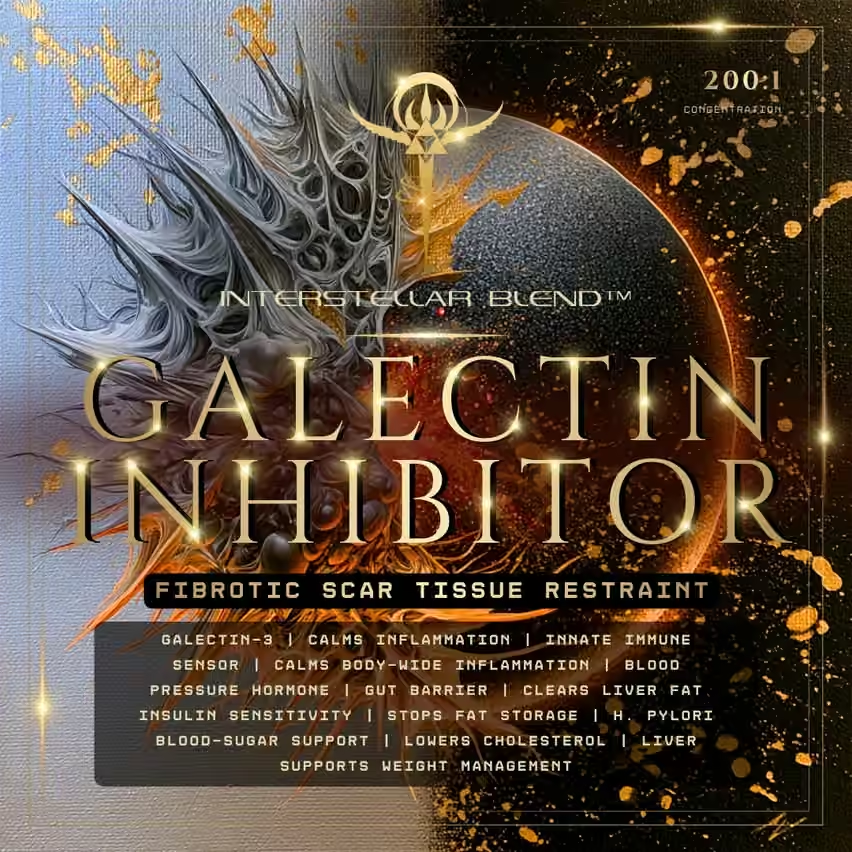
Scar tissue is not damage. It is repair that never received the order to stop.
Galectin-3 is a carbohydrate-binding protein that cross-links the extracellular matrix and holds fibrotic signaling patent long after healing should have concluded — the step at which an ordinary wound response becomes scar. One target rather than a network, which leaves the whole of it unusually legible: nothing compensates for it.
Because that protein rises across the body rather than in one organ, restraining it reaches well past the tissue it is named for. The liver and its fat fraction, insulin sensitivity and blood-sugar handling, blood pressure hormone signaling, the gut barrier, the cholesterol panel, body-wide inflammation and weight all sit downstream of the same molecule. A narrow target is not the same as a small one.
One primary pathway of the fifteen it targets. A pathway opens only on graded, published evidence, shown with its source at the ingredient level.
Educational only. Not evaluated by the FDA.
The story of Galectin Inhibitor (Fibrotic Scar Tissue Restraint)
Galectin Inhibitor — ‘The Stop Order’ — for the repair that never got the order to stop. Scarring is not a malfunction. It is the correct response to an injury, a fast patch that closes a wound before infection can get in. The trouble starts when the patching never stops. The body keeps laying down scar long after the wound has closed, and working tissue is slowly replaced by something that only fills space. In a liver, a lung, a kidney or a heart, that is how an organ loses its function a little at a time. What keeps the patching going is often a single amplifier (galectin-3). It is a sugar-binding protein that sits on the surface of the cells that organize repair, and it does two things at once. It keeps inflammatory cells in the injured tissue longer than they are needed. And it pushes the tissue’s own builders to transform into dedicated scar-makers that lay down collagen without end. Every signal that should say enough is amplified into more. That is why the amplifier matters more than any single scar. It is the reason a healing response turns into a chronic one. Where galectin-3 stays high, the repair crew never hears the call to go home. Galectin Inhibitor is aimed at the amplifier itself. It is built to occupy the protein’s binding pocket, so the signal to keep patching is no longer turned up, the inflammatory cells can leave, and the builders can return to building the tissue that belongs there. Because that protein rises across the body rather than in one organ, restraining it reaches well past the tissue it is named for. Calmed inflammation, body-wide, follows the molecule wherever it had been holding the signal open, and the innate immune sensor that reads tissue damage settles with it. The blood pressure hormone system, the gut barrier and a settled stomach sit downstream; insulin sensitivity, blood-sugar support, fasting insulin, cholesterol and weight read the same restraint metabolically. One molecule — and the whole of what stands behind it. Repair that knows when to stop is called healing. This is the stop order.
Galectin-3 down — anti-fibrotic metabolic.
★ 5.0 · 200:1 · $99


The studies, ingredient by ingredient
Most potent of eight pectins screened: cut heart fibrosis 57% in animals, where citrus pectin managed 30%.
The only galectin-3 inhibitor with human outcome data: PSA doubling time improved in 75% of men at six months and 90% at eighteen.
Enzyme-modified rhubarb pectin binds galectin, the protein that drives tissue to stiffen and scar.
In a registered US university trial, rhubarb extract alone protected kidney function.
Grip strengthens as the sugar chain grows from a single unit to four.
Enzyme treatment opens these pectins' branched sugar arms, and they scored among the most active galectin binders screened.
In hypertensive rats, delayed and softened the onset of high blood pressure, holding back the hormone system that drives it.
Chlorogenic acid blocked the converting enzyme outright, first among phenolic acids in a laboratory comparison.
These grades describe the maturity of the published science for each ingredient — not a claim that the product treats, cures, or is clinically proven for any goal. These statements have not been evaluated by the Food and Drug Administration. This product is not intended to diagnose, treat, cure, or prevent any disease.