Blood pressure is supposed to fall overnight.
Pressure is set by volume, vessel tone and stiffness, each under its own control. Volume and tone run through the renin–angiotensin–aldosterone system (RAAS) and hydration; tone is opposed by endothelial nitric oxide made from its precursor and from dietary nitrate (eNOS, arginine, nitrate). Stiffness is structural; sodium load sets the volume term; a gasotransmitter relaxes vessels beside nitric oxide (H₂S); and the gut contributes along its own vascular axis. The hypertensive disorder of pregnancy stands as a risk of its own and is treated as one (preeclampsia). A pressure that does not fall overnight remains a finding in its own right.
Pressure is behavioral and inflammatory as well as mechanical. Sympathetic drive sets the tone a vessel starts from, inflammatory signaling and IL-6 stiffen the wall across years, reduced scarring is what keeps it compliant, and weight is the volume term no prescription covers. Resistance to infection counts where the endothelium is itself the barrier.
Fourteen primary pathways of the twenty it targets. A pathway opens only on graded, published evidence, shown with its source at the ingredient level.
Educational only. Not evaluated by the FDA.
The story of Pulsar (Vascular Pressure Regulation)
Pulsar — ‘The Night Watch’ — for the pressure that should fall while you sleep. A pulsar is a collapsed star that sweeps a beam across space with a regularity so exact that astronomers once took it for a signal. Your circulation keeps a rhythm like that. Every beat sends a wave of pressure through your arteries (blood pressure), and every night, when all is well, that pressure falls by a meaningful margin while you sleep (nocturnal BP & dipping). The night watch is when the whole system rests. In many people it never does. The pressure holds through the night, the vessels never get their hours off, and the wear that high pressure causes runs around the clock rather than only by day. Pressure is set in the vessel wall. A layer of muscle sets the tone of every artery (smooth muscle), squeezed tighter when calcium floods into it (vascular calcium tone) and loosened by gases the vessel lining releases. The best known of those gases is nitric oxide, made by an enzyme in the lining (eNOS) from an amino acid it shares with other enzymes (arginine), and made by a second, older route from the nitrate in vegetables (dietary nitrate). A third gas works alongside it (hydrogen sulfide, H2S). Pressure is also a matter of volume. A hormonal chain decides how much salt and water the body holds on to (the renin-angiotensin system), and it answers to the salt you eat (dietary sodium load) and to the balance of water and minerals you take in (hydration & electrolytes). Even the bacteria in your gut take part, producing compounds that tighten or relax the vessels (gut microbial metabolites). Over the years, high pressure stiffens the arteries themselves, so the pulse wave races through them faster and lands harder (arterial stiffness, PWV). And in pregnancy, pressure that should never be there can put two lives at risk at once (preeclampsia). Pulsar works on every setting of that system. The wall relaxed and its calcium squeeze eased. The relaxing gases supplied by every route. The salt-and-water chain rebalanced. The arteries kept supple. And the rhythm that matters most restored: the fall that should come every night. Pressure is behavioral and inflammatory as well as mechanical. Gasotransmitter signaling relaxes vessels beside nitric oxide, and the gut-vascular axis contributes along a route most people never hear named. Sympathetic drive sets the tone a vessel starts from, inflammatory signaling stiffens the wall across years, reduced scarring is what keeps it compliant, and weight is the volume term no prescription covers. Resistance to infection counts where the endothelium is itself the barrier — the lining that holds pressure is the same lining holding everything else out. The watch never ends. It only needs to be kept at the right pressure.
Blood-pressure support across nine witnessed pathways — vascular relaxation, RAAS balance, night-time rhythm and arterial flexibility.
★ 5.0 · 200:1 · $99








The studies, ingredient by ingredient
In hypertension, lowered systolic pressure 8.3 mmHg and diastolic 5.5, comparable to standard medication.
Lowers blood pressure even without its nitrate; its betalains and flavonoids carry the effect.
In a randomized, triple-blind, placebo-controlled crossover in 52 people with hypertension, systolic pressure went from 141.2 to 130.0 and diastolic from 92.2 to 84.2 over four weeks on celery seed extract.
Haridra, as Ayurveda names turmeric, returns nitric oxide to the vessel lining so arteries relax, and slows the fibrous stiffening of heart and artery walls.
Ground flaxseed lowered systolic pressure 4.75 mmHg and diastolic 3.09, robust to every trial removed in turn.
Ginger lowered systolic pressure 6.36 mmHg and diastolic 2.12 mmHg across pooled trials, with the effect strongest in people under fifty and within the first eight weeks.
Hibiscus was tested the way a drug is: outcomes fixed in advance, and trial sequential analysis confirming enough participants had been studied to trust the answer.
Citrulline raised flow-mediated dilation 1.81% — the direct readout of endothelial nitric oxide, which is the pathway it is here for.
Fermented-milk lactobacilli lowered systolic pressure 1.96 mmHg; trials of eight weeks or longer agreed at 2.18 mmHg.
Magnesium's blood-pressure effect is precise about who it is for: in people who are both hypertensive and magnesium-depleted, and particularly those already taking antihypertensive medication, systolic pressure fell 7.68 mmHg.
Controlled-release melatonin lowered night-time systolic pressure 6.1 mmHg and diastolic 3.5 mmHg, in the overnight window where pressure should dip.
Nattokinase lowered systolic pressure 5.55 mmHg and diastolic 2.84 mmHg against control, and in the same trial plasma renin activity fell 1.17 ng/mL/h.
Black seed lowered systolic pressure 3.26 mmHg in a 2016 analysis and 3.06 mmHg when independently re-analyzed seven years later — two separate teams, two-tenths of a millimeter apart.
Pooled systolic reduction 3.86 mmHg, rising to 4.81 over 2.45 in people with hypertension.
The response is J-shaped — that window is where the benefit sits — and it runs stronger, up to about 4.5 mmHg systolic, in people who are hypertensive, hyperlipidemic or older.
Pomegranate lowered systolic pressure 5.02 mmHg. The analysis admitted only trials of pomegranate juice on its own.
Quercetin lowered systolic pressure 3.04 mmHg in the Journal of the American Heart Association pooled analysis; an independent 2024 analysis of 20 randomized trials found it reduced systolic pressure too.
Resveratrol improved flow-mediated dilation by 1.43%, with ICAM-1 down 7.09; four of six trials moved the measure.
Against placebo, safflower oil lowered systolic pressure 8.80 mmHg versus 2.26 and diastolic 3.53 versus 0.70 — roughly 6.5 mmHg once the placebo arm is subtracted.
Til, among the oldest oilseeds of India, carries the lignans sesamin and sesamolin, which spare nitric oxide and let the pressure on the vessel wall ease.
An umbrella review confirms the systolic reduction as clinically meaningful, and a dedicated trial examined its safety alongside anticoagulants.
Over twelve weeks taurine lowered clinic systolic pressure 7.2 mmHg against 2.6 on placebo, and — the harder test — 24-hour ambulatory systolic 3.8 against 0.3.
Ascorbic acid, drawn from citrus and rose hip, protects the nitric oxide made by the vessel lining against oxidation, letting arteries widen and pressure ease.
Across 23 randomized controlled trials in 1,213 people with high blood pressure, potassium by mouth lowered systolic pressure.
Across 13 studies, lowered systolic pressure 3.2 mmHg and diastolic 2.0, confirmed by Cochrane in healthy adults.
Eucommia bark was tested where it counts — 24-hour ambulatory monitoring, not a single clinic reading. In 30 adults with pressure between 120–160 over 80–100, two weeks of eucommia brought the average down 7.5 over 3.9 mmHg against placebo.
Grape seed extract moved two numbers at once in pooled human trials: systolic pressure down 1.54 mmHg and resting heart rate down 1.42 bpm.
Corn silk works through potassium-driven natriuresis — the kidney letting go of sodium, and water with it.
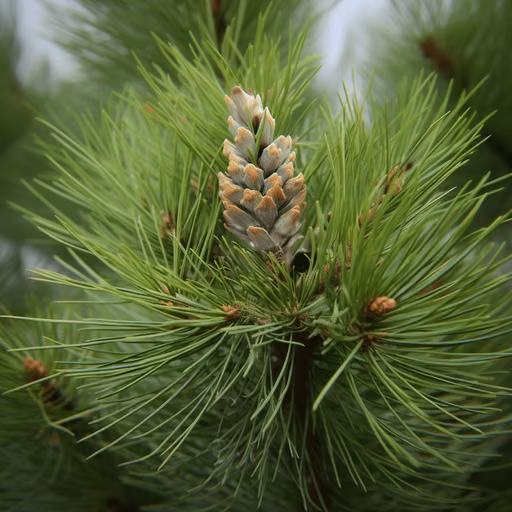
A twelve-week randomized double-blind placebo-controlled trial of Korean pine needle extract reported a significant fall in systolic pressure.
Ge Gen, the kudzu root of classical Chinese formulas, brings the isoflavone puerarin, which restrains the angiotensin hormones that tighten blood vessels.
These grades describe the maturity of the published science for each ingredient — not a claim that the product treats, cures, or is clinically proven for any goal. These statements have not been evaluated by the Food and Drug Administration. This product is not intended to diagnose, treat, cure, or prevent any disease.