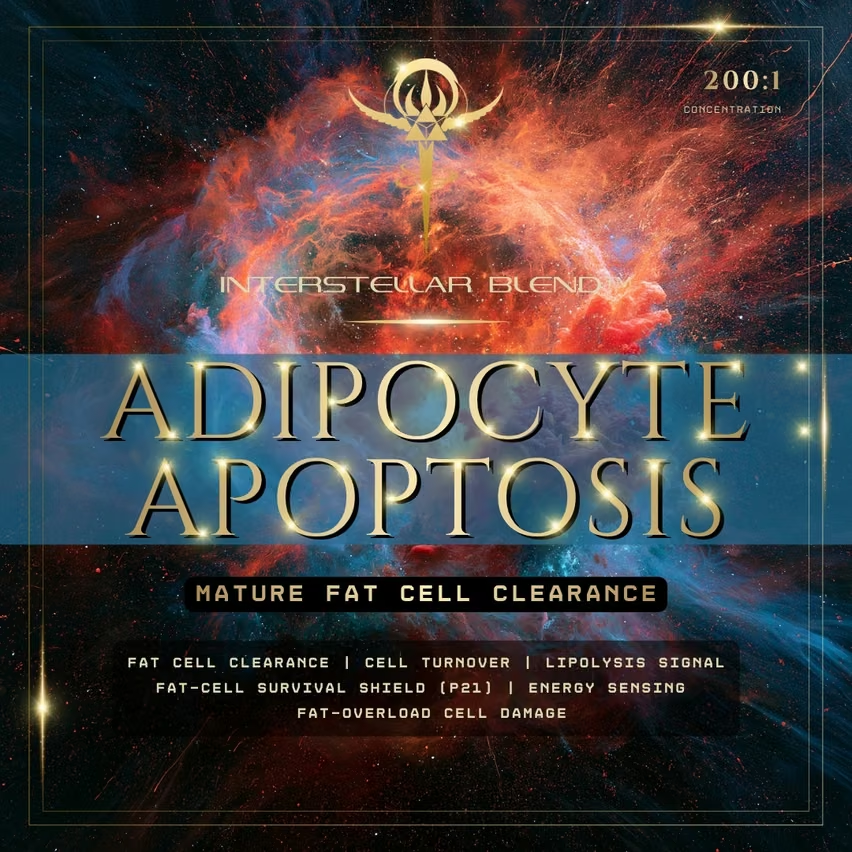
Dieting reduces the volume of adipose tissue without ever amending its census.
A depleted adipocyte is still an adipocyte and keeps every instrument it needs to refill — the arithmetic behind regain, and the reason a body defends one weight repeatedly. Lowering the count requires programmed death in a mature cell (apoptosis, fat cell clearance), and mature adipocytes are refractory to it: a survival protein holds the program in abeyance (p21). The lipolytic kinase and the energy sensor work upstream of that decision (PKA, AMPK), emptying the cell first, since a full one is not given permission to die. Cell turnover is the single measure here that does not come back.
Five primary pathways. A pathway opens only on graded, published evidence, shown with its source at the ingredient level.
Educational only. Not evaluated by the FDA.
The story of Adipocyte Apoptosis (Mature Fat Cell Clearance)
Adipocyte Apoptosis — ‘The Headcount’ — for the fat that keeps coming back. Every organization that has ever had to shrink learns the difference between a smaller budget and a smaller staff. Cut everyone’s hours and the building stays full of people, waiting for the hours to return. Reduce the headcount and the building is simply smaller. Fat works the same way. When you lose weight, your fat cells do not leave. They empty. Each one shrinks, keeps its place and waits, sending up signals that it is underfilled, which is a large part of why lost weight so often finds its way back. The number of fat cells an adult carries is remarkably stable, and they are replaced only slowly across the years. Diet changes their size. It rarely changes their number. There is a second way out, and it is the one that changes the number. Like every cell, a fat cell can be retired: taken apart from within, quietly, without inflammation, its contents cleared away (programmed fat-cell death). It is the same clean exit the body uses everywhere to remove cells it no longer needs (apoptosis). That exit is governed by signals the fat cell already answers to. The key that turns when fat is released (protein kinase A) and the fuel gauge that reads the cell’s energy state (AMPK) both have a say in whether a cell carries on or is retired. Standing against them is a guard protein that shields cells from the exit (p21), keeping even a failing fat cell on the payroll. Adipocyte Apoptosis is built for the headcount. It turns the key and the fuel gauge toward retirement, eases the guard that keeps surplus cells alive, and lets the clean exit do what it does everywhere else in the body: remove what is no longer needed, without harm to what remains. Cell turnover is the one measure in this whole account that does not come back once it has moved. Fewer fat cells, not emptier ones. It is the difference between weight that is lost and weight that stays lost.
Fat-cell number down — programmed death of mature fat cells.
★ 5.0 · 200:1 · $99







The studies, ingredient by ingredient
Drove programmed fat-cell death in four laboratories across two species, and in human fat cells.
Quercetin kept AMPK switched on in the visceral fat of mice on a high-fat diet, in two independent laboratories; a third laboratory saw no change in the fat under the skin.
Soy's genistein raised programmed fat-cell death in the subcutaneous inguinal fat of mice. Apoptosis in the inguinal fat rose 290%.
Bitter melon seed oil increased the crowns of dead fat cells in visceral fat and reduced the size of the fat pad itself.
Whole green tea raised the share of dying fat cells in visceral mesenteric fat, and a second laboratory measured the apoptosis enzyme caspase-2 rising. Apoptotic cells in visceral fat rose to 320.4% of control.
The classical three-herb formula raised programmed cell death in the visceral fat of diabetic mice.
A polysaccharide from reishi raised the executioners of programmed cell death, caspase-3, caspase-6 and Bax, and lowered Bcl-2, the protein that holds them back, in the visceral fat of diabetic mice.
The omega-3 fatty acid DHA set off programmed death of fat cells inside living fat tissue, the nucleus condensing as the apoptosis proteins rose; shown in grass carp, a fish.
Pine bark extract switched on protein kinase A, the adrenaline relay inside the fat cell, in the visceral fat of mice.
The flavor molecule of hazelnuts raised cyclic AMP and switched on protein kinase A in the fat tissue of mice on a high-fat diet.
Gotu kola lowered p21, the shield that keeps enlarged fat cells alive, in the white fat of mice on a high-fat, high-fructose diet.
Taken long term, green tea’s EGCG lowered p21 in the fat of aging mice, where it had climbed steadily in the animals without it.
A food-grade probiotic strain lowered p21 in the fat under the skin of mice with accelerated aging, by roughly half.
Jiaogulan switched AMPK back on in the white fat of mice on a high-fat diet, more so as the amount rose.
The blue-green alga raised AMPK activation inside white fat, alongside the markers of fat that burns rather than stores.
Danshen’s salvianolic acid A raised the active form of AMPK in white fat roughly six- to nine-fold over a high-fat diet alone.
Berberine raised the active form of AMPK in the fat under the skin of mice on a high-fat diet.
Luteolin switched on AMPK signaling in the fat under the skin of mice.
Rutin raised the active form of AMPK in both the visceral and the subcutaneous white fat of mice on a high-fat diet.
Kaempferol raised the ratio of active to total AMPK in the fat under the skin of mice, on a normal and a high-fat diet alike.
Ginseng’s ginsenoside Rg1 raised AMPK activation in the visceral fat of obese mice.
Alpha-lipoic acid restored AMPK activation in the fat under the skin of rats after the loss of ovarian hormones.
Dietary curcumin raised the active forms of AMPK and its target ACC in the fat under the skin of mice on a high-fat diet.
Cocoa’s procyanidins raised AMPK activation in the white fat and the liver of mice on a high-fat diet.
Steamed ginger extract restored AMPK activation in the white fat of mice on a high-fat diet.
Chokeberry’s principal anthocyanin restored AMPK activation in the white fat of rats on a high-fat diet.
A water extract of Atractylodes rhizome restored AMPK activation in the visceral fat of obese mice.
Moringa extract raised AMPK activation in the visceral fat and the liver of mice on a high-fat diet.
Dietary garlic raised AMPK activity in the white fat of mice on a high-fat diet.
These grades describe the maturity of the published science for each ingredient — not a claim that the product treats, cures, or is clinically proven for any goal. These statements have not been evaluated by the Food and Drug Administration. This product is not intended to diagnose, treat, cure, or prevent any disease.